
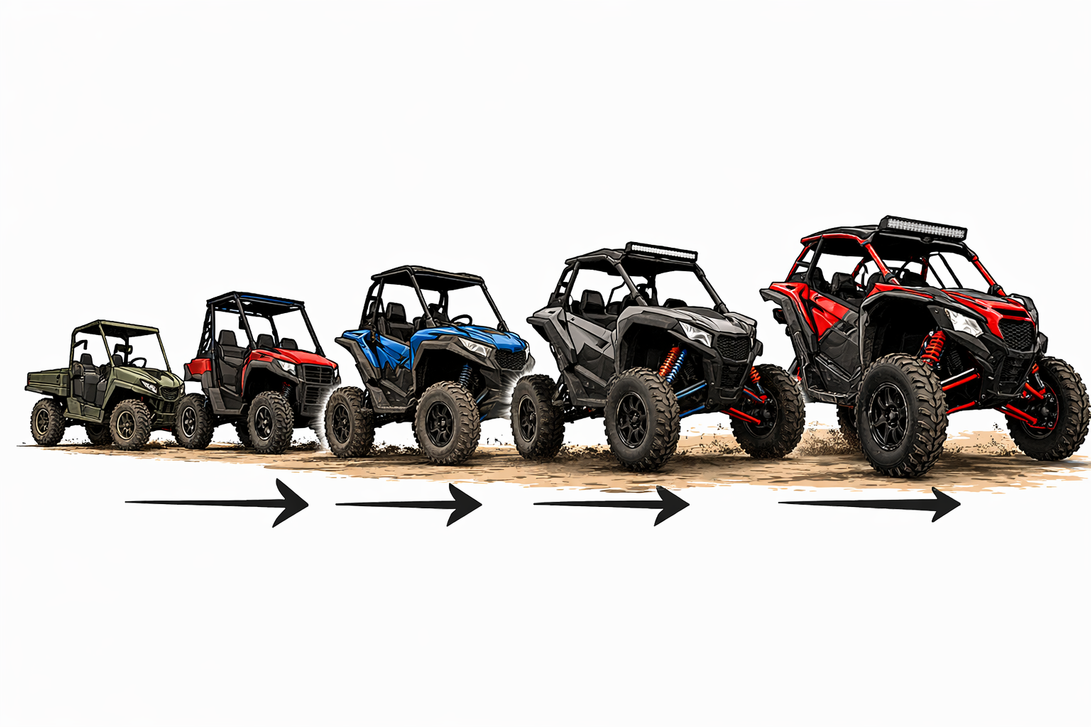
Over the last decade, the sport UTV / side-by-side (SxS) market has experienced one of the fastest technological evolutions in powersports history. What started as simple recreational machines has rapidly transformed into high-performance off-road vehicles capable of competing with trophy trucks in capability and technology.
From turbocharged engines and long-travel suspension to advanced electronic driver aids and race-inspired chassis designs, modern UTVs have become a centerpiece of the off-road industry.
If you’ve been riding since the mid-2010s, you’ve likely watched this transformation happen in real time. Let’s break down the major mechanical and technological advancements that shaped the sport UTV industry over the past 10 years.
The Horsepower Wars: Turbocharged UTV Engines
Perhaps the most obvious change in the sport UTV market has been the massive increase in horsepower and engine performance.
In the early days of the sport side-by-side segment, machines like the Polaris RZR 800 produced around 50 horsepower. Fast forward to today and modern high-performance UTVs can exceed 200 horsepower from the factory.
A major turning point came in the mid-2010s with the introduction of factory turbocharged UTV engines.
Key innovations include:
-
Factory turbocharging
-
High-performance EFI engine management
-
Improved CVT clutch systems
-
Stronger driveline components
-
Liquid charge-air cooling
For example, early turbo machines like the Polaris RZR XP Turbo introduced factory forced induction producing around 144 horsepower, setting a new benchmark for sport SxS performance.
Today, the horsepower race continues with platforms like:
-
Can-Am Maverick R
-
Polaris RZR Pro R
-
Turbocharged Maverick X3 models
Modern machines can push 240 horsepower, with some naturally aspirated engines producing more power than early turbo models did just a decade ago.
For riders, this means higher top speeds, faster dune climbing, and significantly improved acceleration across desert, trail, and rock-crawling terrain.
Long-Travel Suspension & Race-Inspired Chassis
Another area where sport UTVs have seen explosive growth is suspension technology.
Early side-by-sides had roughly 9–12 inches of suspension travel, but modern high-performance sport UTVs now deliver over 20 inches of travel in some platforms.
Advancements include:
-
FOX internal bypass shocks
-
Remote reservoir suspension
-
Dual-rate coilover systems
-
Trailing arm rear suspension
-
High-clearance A-arms
-
Electronic active suspension
Modern sport SxS platforms feature race-inspired suspension geometry designed to absorb high-speed desert terrain, dunes, and rock obstacles.
Some newer models even incorporate electronically controlled suspension systems like FOX Live Valve or Smart-Shox, which automatically adjust damping in real time depending on terrain and driving style.
This technology allows drivers to hammer through whoops, land jumps, and tackle rock gardens with more control and stability than ever before.
Bigger, Wider, and More Capable
Over the past decade, UTV chassis design has dramatically evolved.
Key changes include:
-
Wider stance (64-74 inches)
-
Longer wheelbases
-
Stronger tubular steel frames
-
High-strength driveline components
-
Larger tires and beadlock wheels
Many early sport UTVs were 50–60 inches wide for trail access. Today’s high-performance machines often push 72-74 inches wide, dramatically improving high-speed stability and cornering.
Larger 30- to 32-inch off-road tires, reinforced axles, and stronger drivetrains have made modern machines far more capable in extreme terrain.
Smart Electronics & Driver Technology
Sport UTVs have also become significantly more advanced electronically.
New technology now common in the industry includes:
-
Electronic Power Steering (EPS)
-
Drive modes (Sport / Trail / Rock / Sand)
-
Dynamic traction control
-
Digital touchscreen displays
-
GPS ride command systems
-
Integrated accessory control systems
Many modern machines allow riders to adjust throttle response, suspension stiffness, traction control, and steering feel with the push of a button.
The integration of vehicle electronics, ECU tuning, and data displays has brought sport UTVs closer to automotive-level technology than ever before.
Factory Performance Platforms
Manufacturers have increasingly leaned into race-inspired platforms built specifically for aggressive off-road driving.
Major developments include:
-
Turbocharged sport UTV platforms
-
Naturally aspirated high-revving engines
-
Ultra-wide suspension packages
-
4-seat high-performance models
-
Dedicated desert and rock-crawling packages
The introduction of machines like the RZR Turbo S, Can-Am Maverick X3, and Polaris Pro R pushed the industry into a new era of factory performance UTVs designed for high-speed off-road racing and recreational driving.
These platforms now serve as the foundation for major events like:
-
King of the Hammers
-
UTV World Championship
-
SCORE desert racing
-
Best in the Desert
The Explosion of the UTV Aftermarket
As sport UTV performance increased, so did demand for aftermarket UTV upgrades and performance parts.
The modern UTV aftermarket now includes:
-
UTV suspension upgrades
-
performance clutch kits
-
ECU tuning and turbo upgrades
-
long-travel suspension kits
-
beadlock wheels and off-road tires
-
UTV armor and skid plates
-
LED light bars and accessories
For many riders, building a UTV has become similar to building a Jeep, desert truck, or rock crawler—a platform for personalization and performance upgrades.
The sport UTV industry has grown into a multi-billion-dollar ecosystem of parts, accessories, and off-road innovation.
What the Future Holds for Sport UTVs
Looking ahead, the next generation of side-by-sides will likely continue pushing technological boundaries.
Emerging trends include:
-
Dual-clutch transmissions
-
advanced traction management
-
active suspension systems
-
bigger displacement engines
-
electric and hybrid UTV platforms
-
integrated vehicle telemetry
With manufacturers constantly competing for more power, better suspension, and smarter electronics, the sport UTV market shows no signs of slowing down.
The past decade has transformed sport UTVs from simple recreational machines into high-performance off-road vehicles capable of extreme speed, durability, and technology.
From turbocharged engines and long-travel suspension to smart electronics and race-inspired chassis designs, modern side-by-sides are more capable than ever.
And as the UTV aftermarket and off-road community continue to grow, the next decade will likely bring even more innovation to the sport.